
Why I don't drink
The reason I stopped isn't the reason I'll never go back.

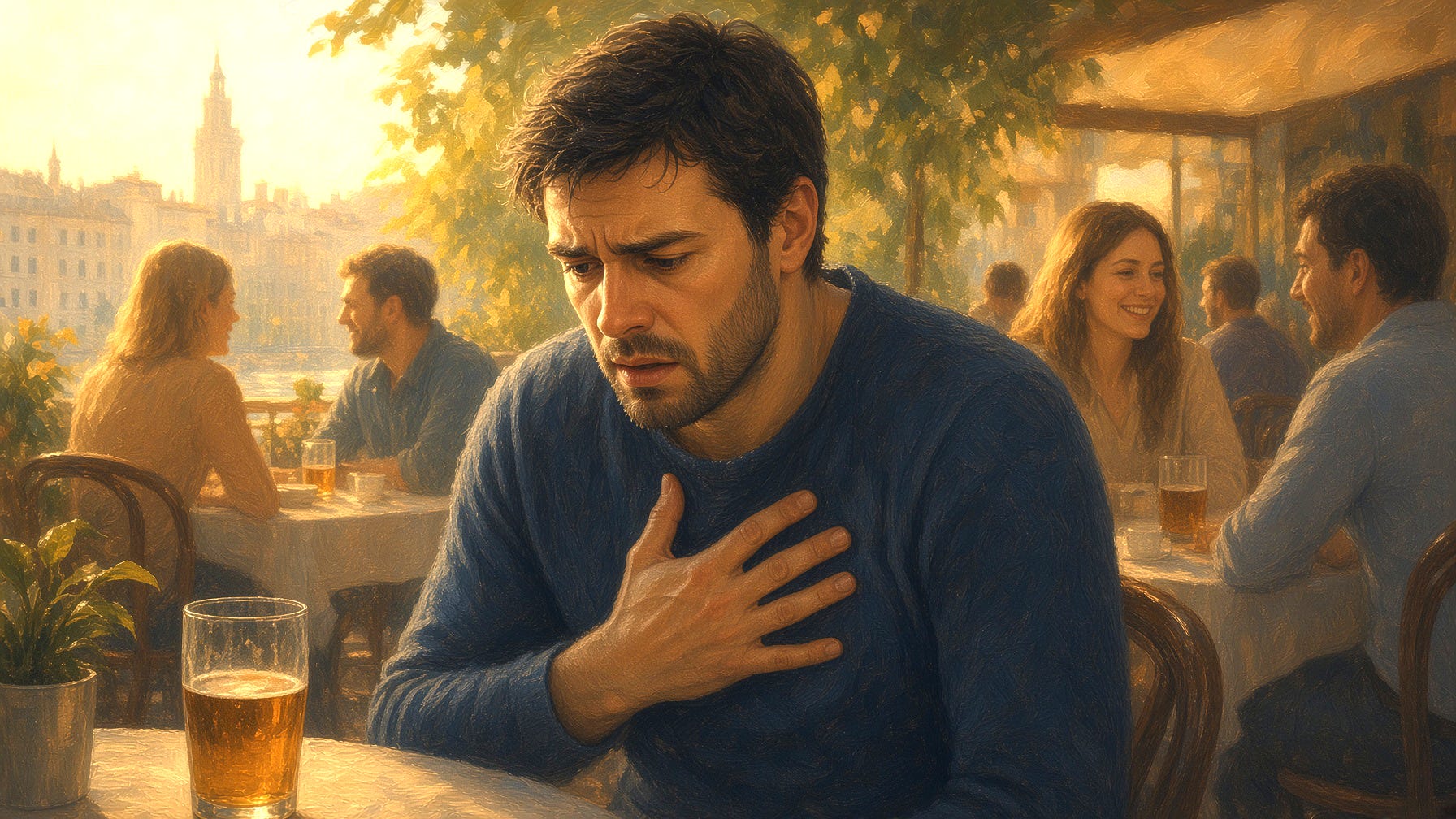
I woke up in cold sweat.
Held my hand on my chest and counted my pulse in the dark.
It was racing.
This is the night it happens.
Now, I know what you’re thinking. Wasn’t this supposed to be about drinking?
I’ll get to that. But the story starts somewhere else.
What it actually was
At 34, I had begun to fear the silence. That’s when it usually came.
My fear would show up in my body as a heart attack. I’d wake soaked with my heart galloping, certain the reaper had come early.
They were panic attacks. But it took me a while to understand that.
What took longer was understanding where they came from, because nothing in my life had changed except one thing:
My daughter had been born.
I wasn’t afraid of dying. I was afraid of what would happen to her if I wasn’t there to protect her.
For the first time I cared about a life more than my own, and my mind handed the weight of it straight to my body.
And it wasn’t only at night.
Sitting in a conference room at work, my body screamed that I was dying while a colleagues talked through something on a screen. It took everything I had to keep my face neutral so nobody could tell.
By then I at least knew what it was, which meant I could hold it down instead of calling an ambulance.
“Inhale slowly. Exhale. Remind yourself this is fear and nothing more.”
I fought them for a year and they faded as I practiced. Not overnight. Just less and less often, until they were rare.
The beer
I was out with friends, eating at a restaurant, drinking a beer in the sunlight.
As the alcohol came on, I felt myself lose a small piece of control over my own body.
That was enough. The fear came straight back up, my heart started going, and I was in a full panic attack at the table.
I never had another drink.
But that’s not why I don’t drink.
Here’s the part that surprised me.
The panic attacks have been more or less gone for years. If they were the reason, I’d have started again the moment they stopped.
That was the obvious moment to go back, and it never even occurred to me.
The attacks were the stop. Everything that came after is why it stayed stopped, and none of it has anything to do with fear.
I was never much of a drinker anyway
At university we had corridor parties a few times a semester, and I went genuinely wild at those.
Sharing a single piece of chewing gum with about ten people in a circle.
Starting a feud with the floor below by pouring an enormous amount of flour down the length of their hallway and onto their kitchen sofa.
It seemed like a good idea at the time.
But between those parties, nothing. A beer here and there. No habit forming, no pull.
That was fifteen years ago and I remember all of it as fun. I’m not writing this from a position of having suffered.
So the price of quitting was low for me, and I want to be honest about that.
I’m not describing willpower. I’m describing a man who gave up something he barely wanted.
The ledger
What I did want was to not end up like the men around me.
I watched too many of them let themselves go in their thirties and forties.
I decided early that wasn’t going to be me. I want to be the man who moves like he’s twenty years younger when he’s sixty.
So I started moving. Thirty burpees a day, then fifty, which is a streak I’ve kept for 702 days. Then kettlebells. Then the food.
All of it aimed at a life that compounds for thirty years.
Once you’re building for that, alcohol stops looking like a treat and starts looking like a tax.
My diet has indulgence built into it, because it has to be realistic. Pleasure isn’t the enemy and this isn’t a purity argument.
Alcohol is just poor value.
And the cost isn’t abstract.
Two beers on a Friday costs you Saturday. Nothing you’d notice. The workout session is just flat instead of strong. But do it weekly and that’s fifty-two compromised weekends a year. Every year. For thirty years.
Nobody drinks thirty years of weekends. They drink one beer, on a Friday, in the sun.
That’s how the compounding gets you. In both directions.
What actually happens
I get asked about it a lot. Why don’t you drink?
And drinkers generally don’t love it when someone doesn’t. It’s a bit like how an honest cop makes the crooked ones nervous.
So they push, at first. But that’s exactly where having no negotiation pays. There’s nothing to push against, and they work that out fast.
Weddings, work dinners, new people. A few questions, then everyone forgets.
I hold a San Pellegrino or a Coke Zero and it looks enough like a drink to be comforting for them, and isn’t one, which is comforting for me.
There’s a better question underneath all of it, though.
Everyone already knows alcohol is bad for them. That isn’t contested by anybody, including the people drinking it.
So why does near-total agreement produce almost no change in behaviour?
I don’t think it was ever a knowledge problem. Nobody needs another study. It’s a belonging problem, and no amount of evidence solves that one.
Which is why I think the practical answer isn’t willpower. It’s staying in the room. Same table, same people, same late nights, glass in hand.
Because you don’t actually miss the alcohol as much as you miss being one of the men at the table.
But there’s one thing that matters to me even more than that.
I’m on call
Fatherhood is a state of permanent readiness. Closer to a doctor on call than anything else I can compare it to.
She may need me at three in the morning, and she needs all of me.
Not the version who can’t drive, can’t think straight, can’t carry her down a staircase.
Every drink buys a few hours of being unavailable to the one person who might genuinely need me.
The decision you only make once
Moderation requires a decision every time. Zero requires none.
The mistake is trying to drink less. It sounds like the reasonable middle path and it’s the hardest version of this there is, because every occasion reopens the question and you have to win the argument again. Tired. At a wedding. With everyone watching.
It’s the same mechanism I use for the daily burpees and for my investing.
The discipline was never the point. Removing the negotiation is.
I decided once that alcohol is a net negative to the man I’m working to become. There’s nothing left to decide.
I don’t wake up at three in the morning convinced I’m dying anymore.
But I do still wake up at three in the morning, because that’s when small children need things.
My body worked out what my head hadn’t yet.
There’s a small person who might need me at three in the morning, and when she does, I want to be the man who can carry her.
P.S. The whole framework I run for this is in the Iron & Gold Starter Kit: how I eat without counting anything, the daily anchor habit that’s held for nearly two years, and where I put my money.
It’s built on one idea, which is that the decisions you only make once are the ones that hold. Get it free at: IronAndGoldStarterKit.com